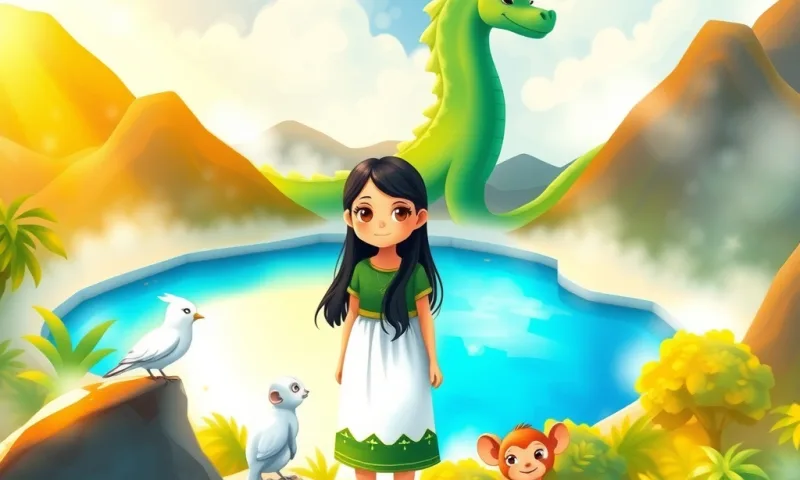
 Once upon a time, in a small village on the slopes of Mount Mahameru, there lived an old widow named Ibu Rukmi. She lived with her daughter, who was beautiful and kind-hearted, named Anjani. Since childhood, Anjani had been different from other children. She did not like playing with dolls or dressing up, but preferred to help her mother in the rice fields and care for the livestock. However, there was one thing that often made Anjani the subject of the villagers' mockery: she was extremely honest and innocent, so much so that she was sometimes considered foolish. Even so, Anjani never got angry. She always smiled and said, "Honesty is the most precious treasure, Mother."
One day, while gathering firewood in the forest, Anjani found a small cave hidden behind a waterfall. Inside, there was a golden glowing egg. Anjani felt sorry for the egg and brought it home. She cared for the egg with great affection, wrapping it in a warm cloth and placing it near the hearth. Night after night, Anjani prayed that the egg would hatch into a good creature. Until one full moon night, the egg hatched! Out came a small bird, pure white with eyes as bright as stars. Anjani named it "Jali," short for "Jalinan Kasih" (Bond of Love).
Jali grew into a very intelligent and loyal bird. It always followed Anjani wherever she went. However, there was one oddity: Jali could talk! Of course, only Anjani could hear it. Jali often told Anjani about the weather, the animals in the forest, and even where to find sweet fruits. Anjani was overjoyed to have a friend like Jali. They often joked and laughed together, even though the villagers thought Anjani was strange for frequently talking to herself.
During a long dry season, Anjani's village was struck by a severe drought. The wells dried up, the rice fields turned into cracked earth, and the livestock began to die. The villagers panicked and started quarreling with one another. They blamed each other and unfairly took water from the same source. Seeing this, Anjani was saddened. She wanted to help but did not know how. Jali then said, "Anjani, I heard from the other birds that at the peak of Mount Mahameru there is an eternal spring guarded by a kind dragon. But the journey there is very dangerous."
Without hesitation, Anjani decided to go in search of that spring. She took leave of her mother with great respect, kissed her mother's hand, and asked for her blessing. "Mother, please allow Anjani to go and find water for our village. Anjani will be careful," she said politely. Ibu Rukmi wept but gave her daughter her blessing. Anjani set off with meager provisions and accompanied by the loyal Jali. Their journey was full of obstacles: steep paths, dark forests, and wild animals. However, Anjani never complained. She always remembered her mother's message to remain patient and courteous.
Midway through their journey, Anjani met two new friends: a white monkey named Koko and a chatty mouse deer named Cil. Koko was a strong monkey but very forgetful, while Cil was a nimble mouse deer who loved to gossip. The three of them often found themselves in funny situations. Once, Koko wanted to pick a coconut for Anjani, but because he was so forgetful, he climbed a durian tree instead and fell right onto a beehive. "Ouch! The bees are angry! I'm sorry, bees! I didn't mean it!" Koko shouted as he ran helter-skelter. Anjani and Cil laughed uncontrollably at Koko's antics. "Koko, if you weren't so forgetful, you'd surely be king of the jungle!" teased Cil, clutching his stomach that ached from laughing.
Despite their frequent silliness, their friendship was very close. When Cil got stuck in quicksand, Koko and Anjani worked together to help him. Anjani patiently calmed the panicking Cil. "Relax, Cil. We'll definitely get out. Don't talk so much for now, or the mud will rise faster," said Anjani with a smile. Finally, they managed to save Cil. Cil promised not to be chatty anymore, though that promise only lasted ten minutes. "Anjani, you really are the best friend! I'll tell the whole forest about your kindness!" exclaimed Cil excitedly, making Anjani and Koko just shake their heads and smile.
After days of walking, they arrived at the peak of Mount Mahameru. There, they saw a clear lake radiating a bluish light. However, in front of the lake stood a large emerald-green dragon with wise eyes. His name was Naga Bumi. The dragon was not fierce, but he posed three riddles to anyone who wished to take his water. Many failed because they were impatient and answered carelessly. Anjani stepped forward respectfully, bowed politely, and said, "Please excuse us, Your Majesty Dragon. We have come to ask for water for our village, which is suffering from drought. We will answer your riddles as best we can."
The first riddle: "What can put out fire but cannot get wet?" Koko immediately shouted, "Water!" but that was wrong. Cil guessed, "Wind!" also wrong. Anjani thought for a moment, then answered calmly, "Earth, Your Majesty. Earth can cover fire until it goes out, but earth itself does not get wet." Naga Bumi smiled and nodded. The second riddle: "What grows bigger the more you take from it?" Koko and Cil were confused. Anjani smiled and answered, "A hole, Your Majesty. The more we dig, the bigger the hole becomes." Naga Bumi chuckled softly. The final riddle: "What can fly without wings, cry without eyes, and go without legs?" Anjani pondered, then answered with confidence, "Clouds, Your Majesty. Clouds fly without wings, drip rain as if crying without eyes, and move without legs." Naga Bumi was deeply impressed. "You are right, young one. You are not only clever but also patient and courteous. I will give you the water from this spring."
Anjani and her friends returned to the village carrying water from the eternal spring. The villagers were overjoyed. They regretted having mocked Anjani. From that moment on, the village became fertile and prosperous once again. Anjani never became arrogant. She continued to help her mother and always behaved politely toward everyone. Jali, Koko, and Cil often visited Anjani. The three of them always made Anjani laugh with their silly antics. "Anjani, you're the village hero now! But you still love eating roasted corn, right?" Koko asked innocently. Anjani laughed and nodded. "Of course, Koko. Let's go eat roasted corn together!"
Anjani's story spread throughout the entire land. Many people came to learn about honesty, patience, and good manners. Anjani always welcomed them warmly. She often said, "Kindness doesn't need to be shown off. Just do it sincerely, and that kindness will come back to us." Until the end of her life, Anjani was known as Dewi Anjani, a figure who taught that true beauty comes from a good heart, gentle words, and an unyielding spirit. The Jali bird was always faithfully by her side, a silent witness to the life journey of a village girl who became a legend.
The moral message of this story is the importance of honesty, patience, and good manners in facing all challenges. Anjani teaches that intelligence and courage must be balanced with humility and respect for others, especially those who are older. In addition, sincere friendship will always provide strength and happiness, even in the most difficult situations.
This story also reminds us that everyone has strengths and weaknesses. Never look down on others just because they seem different or are considered foolish. Like Anjani, sometimes the simplest people are the ones with the noblest hearts. With an unyielding spirit, honesty, and compassion, we can change the world into a better place.
Moral of the Story
1. Honesty and patience are the main keys to achieving success. Anjani proves that with a sincere heart and courteous speech, we can overcome obstacles of any size.
2. Sincere friendship and mutual support provide strength and happiness. Koko, Cil, and Jali show that differences can actually strengthen bonds of kinship when founded on love and affection.
3. Good manners and politeness toward others, especially those who are older, are a reflection of noble character. Anjani always respects her mother and Naga Bumi, so she receives blessings and help.
4. Never look down on others. Kindness of heart and an unyielding spirit are far more valuable than appearance or intelligence alone.
Leave a Message