 Long ago, at the eastern tip of the island of Java, there lived a powerful brahmin named Sidi Mantra. He lived on the slopes of Mount Agung, which was lightly veiled in mist every morning. The villagers deeply respected him because he always helped others selflessly. Yet behind his fame, Sidi Mantra carried a deep sorrow. His wife had long since passed away, and he had only one son named Manik Angkeran.
Manik Angkeran grew into a handsome and clever young man. Unfortunately, he was very fond of gambling and squandering money. Whenever his father advised him, he would simply smile and walk away. Sidi Mantra often sat lost in thought on the veranda of his wooden house. "My son, why do you listen more to the whisper of dice than to my words?" he sighed softly.
One day, Manik Angkeran's debts piled up everywhere. Debt collectors came one after another to their house. Sidi Mantra was forced to sell the family heirlooms to pay off his son's debts. Seeing his father weep, Manik Angkeran felt a pang of pity. But the temptation of gambling once again defeated the voice of his heart. He asked his father for more capital.
Sidi Mantra finally set a difficult condition. "Go to the Karang Cave, meet the Naga Besukih. Ask for a jewel from its scales. If you succeed, you may use it to pay your debts," said his father in a trembling voice. Manik Angkeran arrogantly agreed. He did not know that the Naga Besukih was a mighty and immensely powerful creature.
On the way to the Karang Cave, Manik Angkeran met a shepherd boy named Gede. Gede was an orphan who was cheerful despite his simple life. "Wow, you're going to the dragon's cave? I'll come along! I know the shortcut by heart!" exclaimed Gede, jumping up and down. Manik Angkeran frowned, but he needed a guide. So they walked together.
Gede turned out to be very talkative and funny. He told stories about his goat named Bulu, who loved to dance in the rain. "When Bulu dances, you have to see it! His legs go like this!" Gede imitated his goat with silly movements. Manik Angkeran, who had been gloomy at first, burst out laughing. That laughter drove away a little of the unease in his heart.
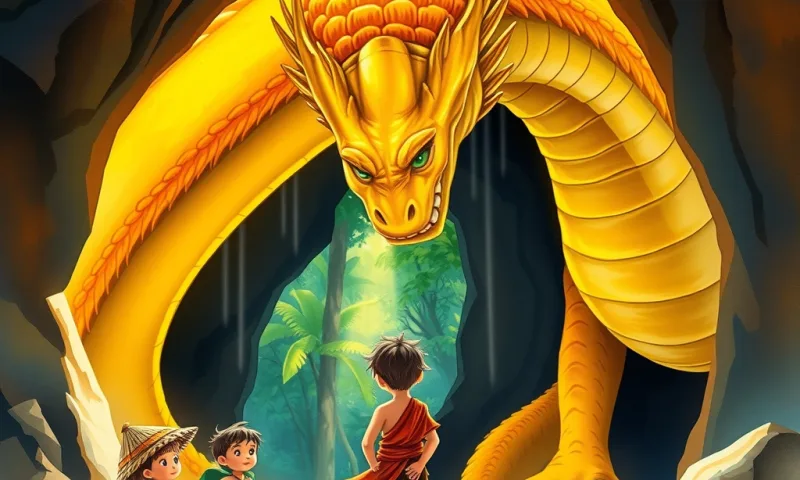
When they reached the mouth of the cave, the air felt cold and smelled of sulfur. Gede suddenly stopped and whispered, "Brother, I hear that dragon is very polite to good guests. So don't forget to greet it, okay!" Manik Angkeran nodded, though in his heart he doubted. He stepped forward cautiously, while Gede hid behind a large rock.
The Naga Besukih emerged from the darkness. Its scales gleamed like gold, and its eyes blazed green. Manik Angkeran trembled with fear. He forgot all of Gede's advice. In haste, he begged for the jewel without offering a greeting and without bowing his head. The Naga Besukih hissed softly, a sign of displeasure at such arrogance.
"Young man, you come without manners. However, I will give you a jewel because I know your father, the wise Sidi Mantra," said the Naga Besukih in a thunderous voice. It dropped a jewel from its scales. Manik Angkeran immediately snatched the jewel and ran out without saying thank you.
Gede chased after him shouting, "Brother! You forgot to say thank you! That's impolite!" But Manik Angkeran was already far ahead. He was too happy imagining the money he would get. When he arrived home, he gambled again. Within days, the jewel was gone. And Manik Angkeran once again asked his father for more.
Sidi Mantra was deeply disappointed. "You have forgotten your manners and your gratitude, my son. I will not give you anything anymore," said the father firmly. Manik Angkeran grew angry and challenged his father. He returned to the Karang Cave to take more jewels. This time, he came arrogantly and forced the Naga Besukih to hand over all his wealth.
The Naga Besukih was furious. With a single flick of his tail, Manik Angkeran was thrown out of the cave. However, because of the dragon's magical power, the young man's body turned to stone. Sidi Mantra, who followed to the cave, could only weep at the sight of his son turned to stone. He regretted having spoiled his child too much.
Gede, who had come along, tried to comfort him. "Father Sidi, do not cry. Brother Manik is at peace now. Perhaps he is dancing with Bulu over there," he said innocently. Sidi Mantra smiled bitterly at the little shepherd boy's naivety. He realized that it was Gede who had a sincere heart despite his difficult life.
Sidi Mantra then pleaded with the Naga Besukih to bring Manik Angkeran back to life. The dragon agreed, on the condition that Sidi Mantra must create a boundary between the world of humans and the world of dragons. So Sidi Mantra thrust his staff into the ground. The seawater parted, forming a deep strait.
Manik Angkeran came back to life, but he had changed into an obedient and polite child. He promised never to gamble again. Sidi Mantra embraced his son with emotion. "Remember, manners and gratitude are the most precious jewels," he advised. Manik Angkeran nodded and apologized to Gede, who had helped him.
From that moment on, the strait that was formed became known as the Bali Strait. It is said that its blue waters hold a message about the importance of respecting one's parents and being courteous. Gede and Manik Angkeran became good friends. They often played together with Bulu the goat on the shore, laughing at their dark past with gratitude.
The nearby villagers believe that anyone who crosses the Bali Strait with good intentions will receive blessings. The story of Sidi Mantra and Manik Angkeran has been passed down from generation to generation. Children are always taught not to be arrogant and to always say thank you. To this day, the waves of the Bali Strait seem to whisper softly, reminding us of a father's love and the importance of good manners.
Behind the beauty of the Bali Strait lies a valuable lesson. Arrogance only brings ruin, while humility opens the door to happiness. True friendship, as shown by Gede, is a priceless treasure. And most importantly, respect your parents and never forget to be grateful for every gift.
So, be a devoted and courteous child in your speech. Like the wise Naga Besukih, we should reprimand in a kind way. Like cheerful Gede, we should comfort friends who are sad. And like Sidi Mantra, we should teach goodness with patience, even when the heart is hurting.
Moral of the Story
The moral lesson of this story is the importance of respecting one's parents and always behaving politely in every situation. Arrogance and ingratitude only bring harm, while humility and gratitude bring happiness. Sincere friendship is also a reminder that the presence of good friends can help us through difficult times. In addition, this story teaches that every action has consequences, and that apologizing and improving oneself are noble steps toward returning to the right path.


Leave a Message